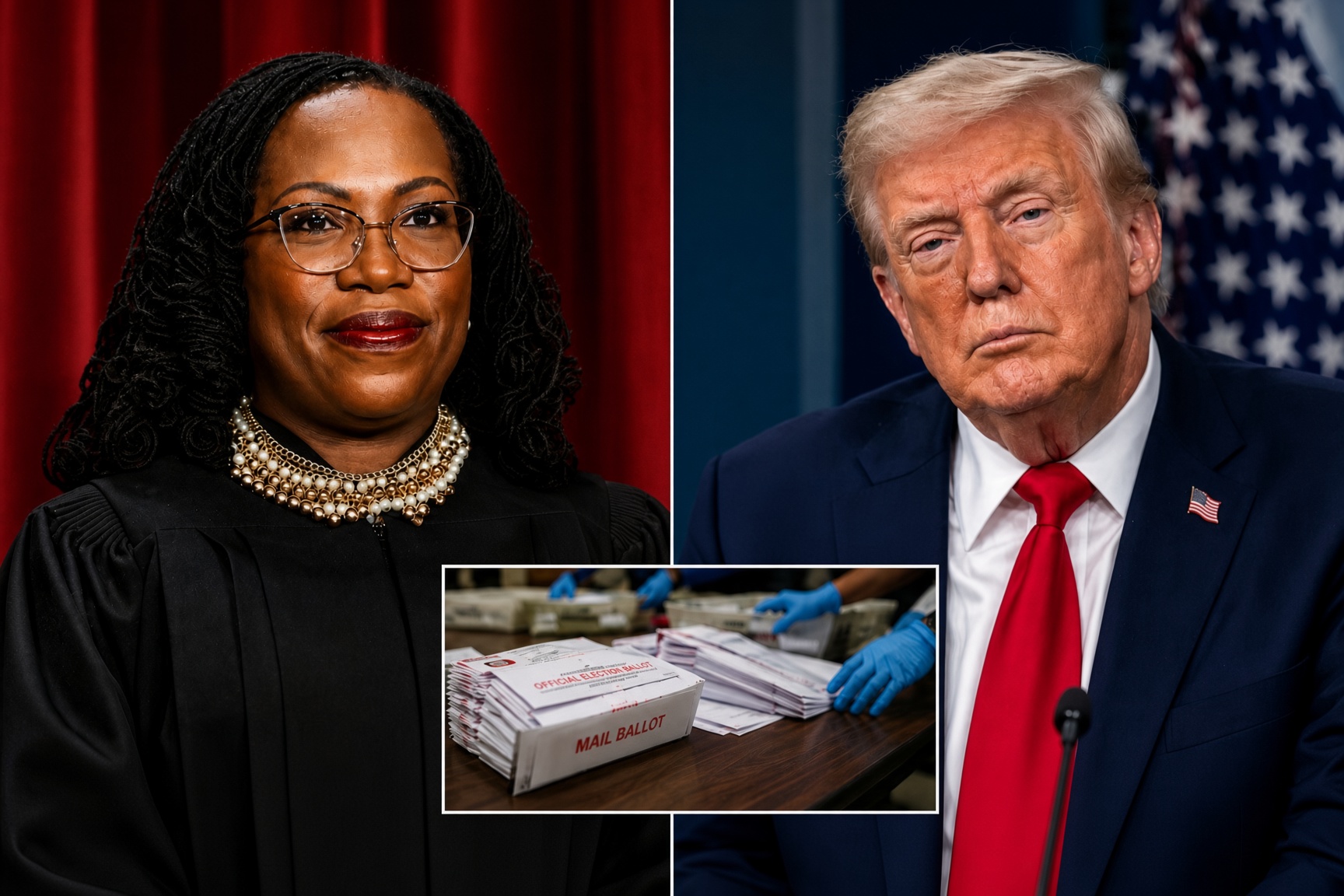
A Supreme Court justice rejected the Trump administration’s emergency request to enforce an executive order restricting mail-in voting in 23 states and Washington, D.C., just months before the midterm elections.
The Trump administration filed an appeal after a federal judge blocked portions of an executive order titled “Ensuring Citizenship Verification and Integrity in Federal Elections” that Trump signed on March 31. The order directed the U.S. Postal Service to deliver mail-in ballots only to voters whose names appear on state citizenship verification lists compiled by the Department of Homeland Security.
What Happened
U.S. District Judge Indira Talwani, appointed by former President Barack Obama, issued an order on June 25 barring enforcement of the mail-in ballot provisions in the 23 states and D.C. that challenged the executive order. The states, led by California, argued the order conflicted with constitutional provisions granting states authority over voter eligibility and election procedures.
On Saturday, a divided panel of the U.S. Court of Appeals for the 1st Circuit rejected the government’s request to overturn Talwani’s decision. The majority wrote that allowing the order “to take effect for the elections taking place” in the fall “would sow confusion and threaten disenfranchisement of many eligible voters.”
The Trump administration asked the Supreme Court on Monday to intervene, with U.S. Solicitor General D. John Sauer arguing the lawsuit was premature because federal agencies had not yet finalized implementation plans.
The Court’s Response
Justice Ketanji Brown Jackson declined the administration’s request for an immediate administrative stay without issuing a formal ruling. Instead, Jackson ordered the plaintiff states to respond to the government’s emergency application within seven days, with responses due by August 23.
Sauer had urged the Supreme Court to issue an immediate stay, contending that a federal judge’s blocking order “flouts settled” legal principles and causes “serious irreparable harm.” He argued there was insufficient time to obtain ordinary appellate relief before the November elections given the timing of election procedures.
What This Means
The decision preserves the lower court’s block on the executive order’s mail-in ballot provisions for now, allowing the legal challenge to proceed through the courts. The Supreme Court’s next action depends on how the states respond to the government’s filing.
The case highlights the ongoing dispute between the Trump administration and multiple states over federal election authority versus state control of voting procedures. The outcome could affect how mail-in voting is conducted in dozens of jurisdictions before the fall midterms.
This story has been updated. CNN’s Digital Politics team contributed to this report.