KEY TAKEAWAYS
- U.S. Navy forces engaged an Iranian vessel in the Arabian Sea after it maneuvered dangerously close to the USS Abraham Lincoln aircraft carrier
- A Navy destroyer fired multiple rounds from its 5-inch cannon, followed by helicopter-launched Hellfire missile strikes that scored direct hits
- The confrontation marks the latest escalation in mounting tensions between American and Iranian naval forces in strategically vital regional waters
- U.S. Central Command has maintained operational secrecy, while the Trump administration frames the carrier deployment as a show of strength against Tehran
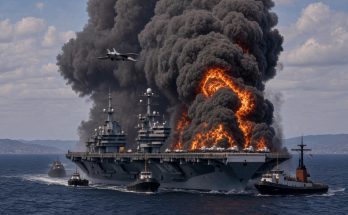
U.S. Navy forces engaged an Iranian vessel in the Arabian Sea this week after it closed dangerously on the USS Abraham Lincoln carrier strike group, triggering direct military action that underscores escalating tensions in one of the world’s most strategically critical waterways. According to military officials, the engagement involved cannon fire from a Navy destroyer followed by helicopter-launched Hellfire missiles that achieved direct hits on the Iranian ship. The incident represents the latest in a series of confrontations between American and Iranian naval assets operating in the region.
Direct Military Response
The USS Abraham Lincoln’s accompanying destroyer responded to the Iranian vessel’s approach by deploying its 5-inch, 54-caliber Mark-45 deck gun-a fully automated cannon system that has served as the foundation of American surface warfare since the 1970s. According to military sources, the weapon system discharged multiple rounds at the approaching Iranian ship. “Multiple rounds missed the target,” the officials stated, though it remains unclear whether the initial volley constituted warning fire or precision strike attempts-a distinction carrying significant tactical and diplomatic implications.
When the cannon fire failed to deter the vessel’s advance, American commanders escalated their response. A military helicopter armed with AGM-114 Hellfire missiles was dispatched and successfully struck the Iranian ship with two direct missile impacts. While officials did not specify the helicopter variant-either an MH-60R Seahawk or Marine Corps AH-1Z Viper-both platforms routinely conduct anti-surface missions from carrier strike group operations.
Pentagon Maintains Operational Silence
U.S. Central Command declined to provide additional details regarding the engagement. “We have nothing for you on this,” a Pentagon spokesperson stated, reflecting standard military protocol during active operations. Full operational assessments typically remain classified until internal reviews conclude and security evaluations are completed.
The Pentagon’s silence contrasts with the Trump administration’s public messaging. In late January, President Donald Trump announced the deployment of an “armada” to the Arabian Sea, explicitly characterizing the carrier strike group’s arrival as a demonstration of American strength against Iranian aggression.
Pattern of Escalation
This week’s engagement represents the latest chapter in a series of confrontations between U.S. and Iranian military forces in Arabian Sea operations. In early February, American forces successfully downed an Iranian Shahed-139 drone that aggressively maneuvered toward the Abraham Lincoln strike group. According to U.S. Central Command assessments, American forces have damaged or destroyed more than 90 Iranian naval vessels since broader military operations commenced.
The USS Abraham Lincoln strike group operates with substantial firepower, including destroyers USS Spruance and USS Michael Murphy, along with additional guided-missile destroyers positioned throughout the operational theater. The carrier’s presence projects American naval dominance while maintaining constant readiness against potential Iranian provocations in these contested waters.
Tactical Considerations
Military analysts attribute the Mark-45 gun’s reported misses to multiple factors, including weapon range limitations, prevailing sea conditions, and the Iranian vessel’s evasive maneuvers. The subsequent Hellfire strikes demonstrated the precision-guided munitions’ effectiveness against surface targets, despite their original design for anti-armor applications.
The Arabian Sea has emerged as a critical theater where naval commanders navigate complex rules of engagement while managing escalation risks. Sailors operating in these waters face persistent hazards as tactical decisions carry consequences extending far beyond individual military engagements.
Fox News Digital / CelebBNews contributed to this report.