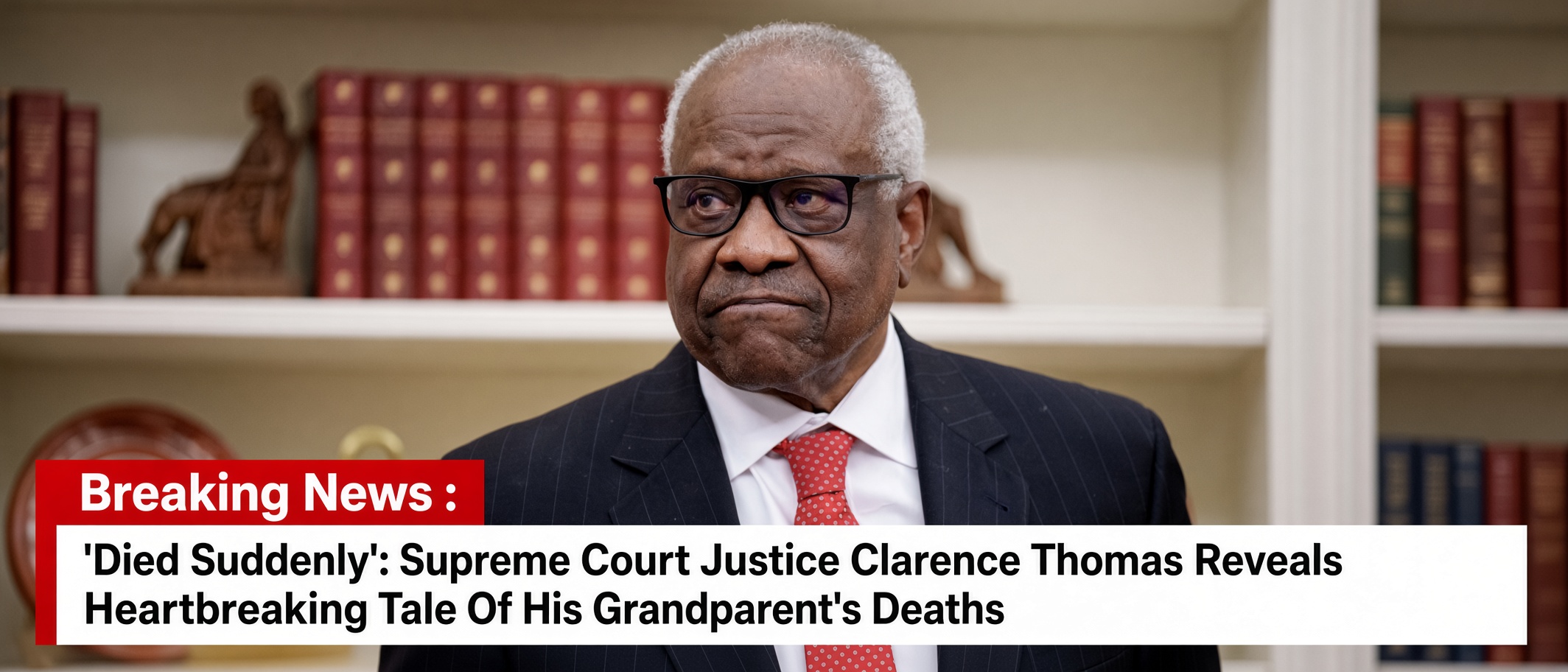
Supreme Court Justice Clarence Thomas became visibly emotional during a wide-ranging public conversation as he reflected on the people and ideas that helped shape the course of his life. For several seconds, the normally reserved justice struggled to continue before explaining why the subject remains deeply personal more than four decades later. Thomas choked up while revealing that after his grandparents both died suddenly in 1983, he made a commitment to honor them through the way he lived the remainder of his own life. “When both my grandparents died suddenly in 1983, the decision I made was to live the rest of my life as a memorial to theirs,” Thomas told Hoover Institution fellow Peter Robinson during an on-stage discussion.
The conversation briefly stopped as Thomas gathered himself and attempted to regain his composure. “And the point I’m going to make is that is the way I feel about Professor Sowell,” Thomas continued, referring to economist and author Thomas Sowell. “All right,” Robinson responded. “Watch this because I’m going to lighten the mood here.” Thomas’ emotional remarks came as he discussed Sowell’s influence on his thinking and the similarities he sees between the economist’s philosophy and the lessons his grandparents taught him as a child.
Thomas was raised by his maternal grandparents in segregated Savannah, Georgia, after his father left when Thomas was seven years old. His grandfather, Myers Anderson, had been raised by a freed slave, and Thomas said his family continued working land that had once been part of a plantation. “We actually lived – farmed on a part of that plantation, and we grew up every summer, we farmed on that plantation,” Thomas said.
Grandparents’ Educational Values
Thomas said his grandfather received only nine months of formal schooling, while his grandmother, Christine Anderson, was educated through the sixth grade. “Even though my grandfather only had nine months of education, the crown jewel was education,” Thomas said. “My grandmother went to the sixth grade, for her the crown jewel,” he added. Thomas described Christine as a “saintly woman” while calling Myers “the single greatest man I’ve ever known.”
The justice said his grandfather emphasized hard work, personal responsibility and developing the ability to overcome obstacles rather than focusing on disadvantages. “It wasn’t taking the measure of what you don’t have,” Thomas said. “It wasn’t to complain about that, but to develop the capacity to do things that you needed to do in order to… improve your life.” Thomas also recalled the memorable response his grandfather would give whenever the young Thomas complained that he could not accomplish something.
Justice Clarence Thomas choked up on stage as he revealed the vow he made when both his grandparents died suddenly in 1983: to live the rest of his life as a memorial to theirs.
Thomas, abandoned by his father at age seven, was raised by his maternal grandparents in segregated… pic.twitter.com/1je1DCeSaR
— Fox News Politics (@foxnewspolitics) August 19, 2026
“His favorite saying was, ‘Old man can’t is dead. I helped bury him,'” Thomas recalled. “And the old man can’t was buried many times in our house,” he added.
Grandfather’s Influence on Thomas’ Philosophy
Justice Clarence Thomas choked up on stage as he revealed the vow he made when both his grandparents died suddenly in 1983: to live the rest of his life as a memorial to theirs. Thomas, abandoned by his father at age seven, was raised by his maternal grandparents in segregated… pic.twitter.com/1je1DCeSaR – Fox News Politics (@foxnewspolitics) August 19, 2026
Thomas said his grandfather’s own life made it difficult for him to justify complaining about obstacles he encountered. “My grandfather, no education, raised by a freed slave, and he never complained,” Thomas said. “He did it.” “He was just a great man,” Thomas continued. “Now what do you do? How do you complain when he had nothing, no education?” “What do you say to it?” Thomas asked. “But he sets this example of how you live your life.”
Thomas said he later encountered many of those same principles while reading Sowell, whose work gave him confidence to reach conclusions that sometimes differed from those expressed by other prominent Black Americans. Thomas particularly pointed to Sowell’s “Race and Economics” and its discussion of the importance of attitudes including self-reliance and self-discipline.
Same Principles Across Generations
“Where did I first hear that?” Thomas asked. “I heard it from my grandfather, the single greatest man I’ve ever known, my grandmother, a saintly woman, my nuns.” “Same thing,” Thomas continued. “It’s the exact same thing.” This article may contain commentary which reflects the author’s opinion.